One factory.
Four products.
A pipeline you can govern.
The Factory family turns a plan into merge-ready, verified software through a chain of autonomous services — each useful on its own, each built to hand off to the next, all following the PARR loop.
flowchart LR
P["PFactory<br/>Prepare · Plan"] --> A["AIFactory<br/>Act · Code"]
A --> T["TFactory<br/>Reflect · Verify"]
T --> S(["Shipped"])
C["CFactory · Review<br/>observe & steer"] -.-> P
C -.-> A
C -.-> T
classDef pf fill:#2b3a37,stroke:#83a598,stroke-width:2px,color:#cfe6de,font-weight:bold;
classDef af fill:#3a2b18,stroke:#fe8019,stroke-width:2px,color:#f6cfa6,font-weight:bold;
classDef tf fill:#33360f,stroke:#b8bb26,stroke-width:2px,color:#e2e4a0,font-weight:bold;
classDef cf fill:#3a3115,stroke:#fabd2f,stroke-width:2px,color:#f6dd98,font-weight:bold;
classDef sh fill:#26331a,stroke:#b8bb26,stroke-width:2px,color:#cfe6b0,font-weight:bold;
class P pf; class A af; class T tf; class C cf; class S sh;
This is the repository for the whole program — cross-cutting plans, the shared pipeline, and the place the four products come together.
New: The Guarded PARR Pipeline — every step and decision from handover to merge, the sixteen guards that protect task & execution, and real adoption scenarios from solo builders to regulated enterprises.
The products
 Prepare / Plan + Review
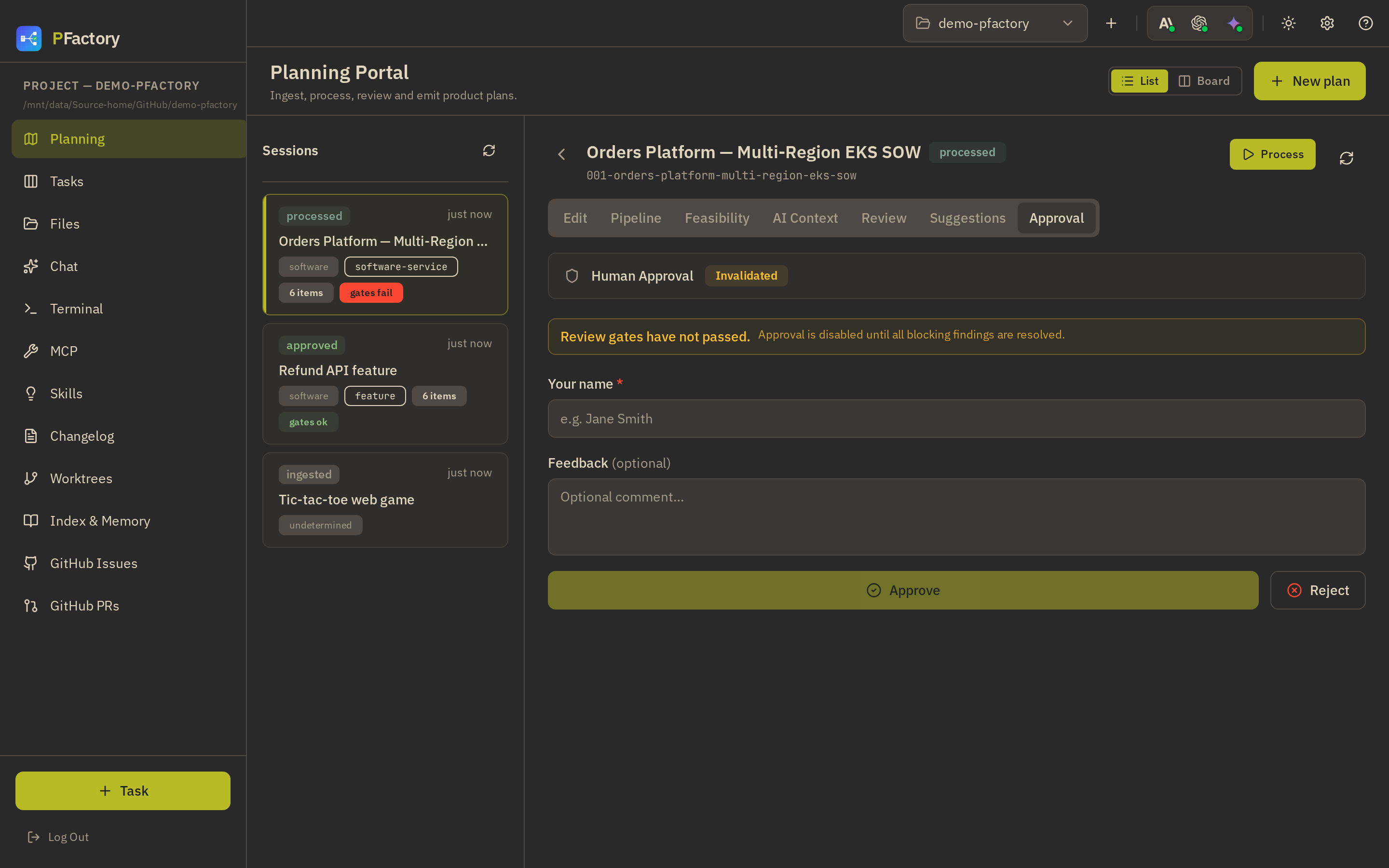
PFactory — governed planning, grounded in your infrastructure
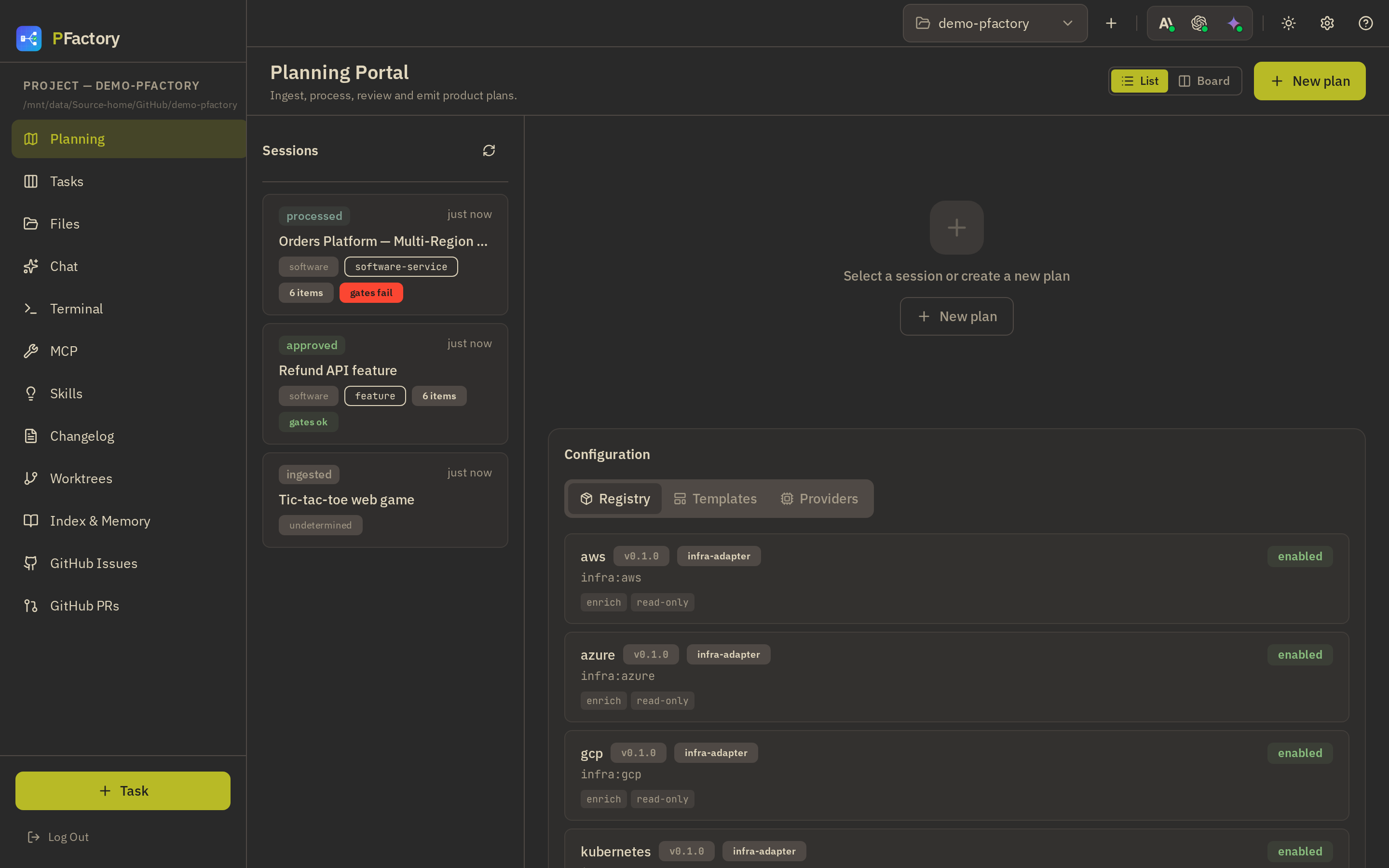
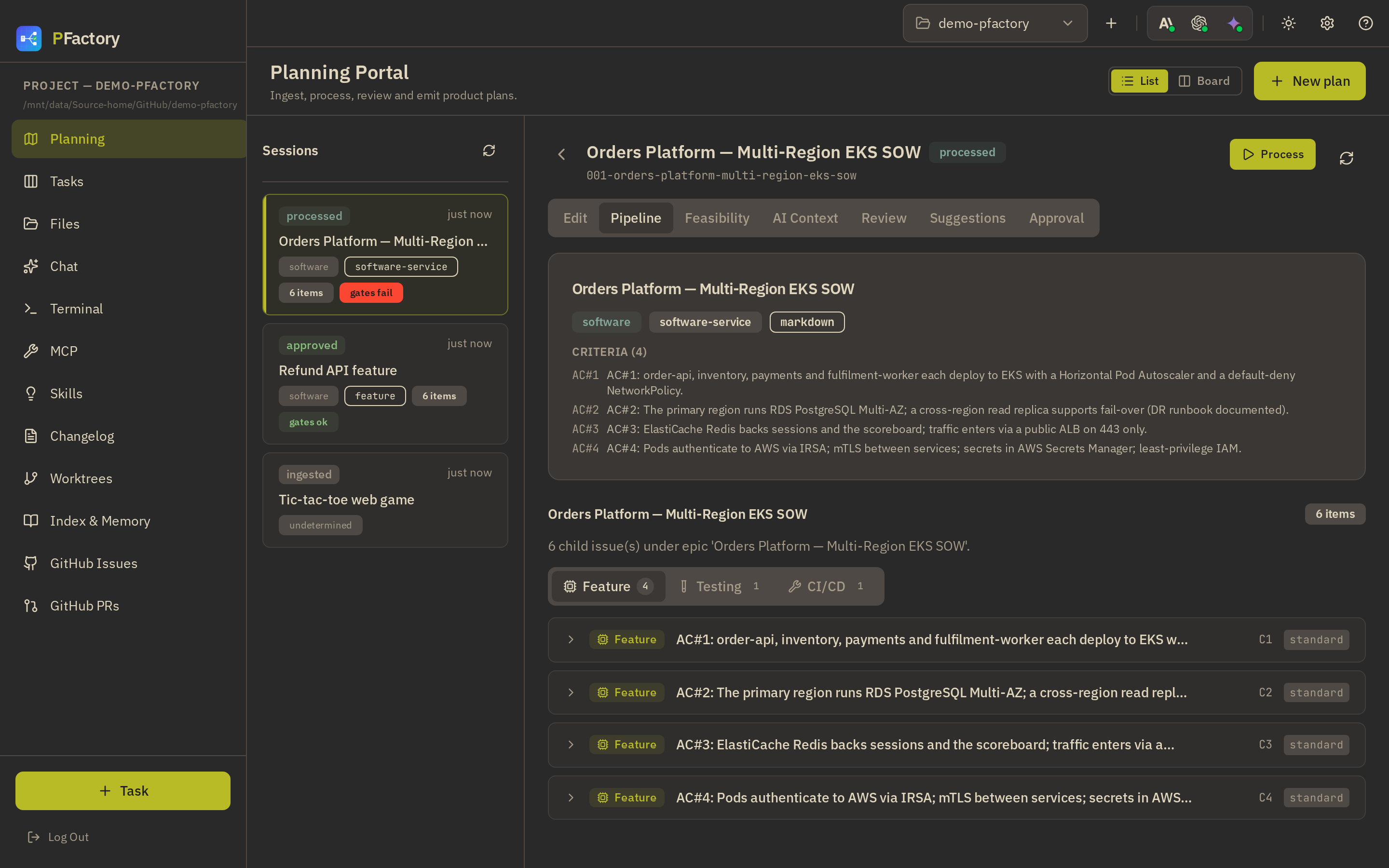
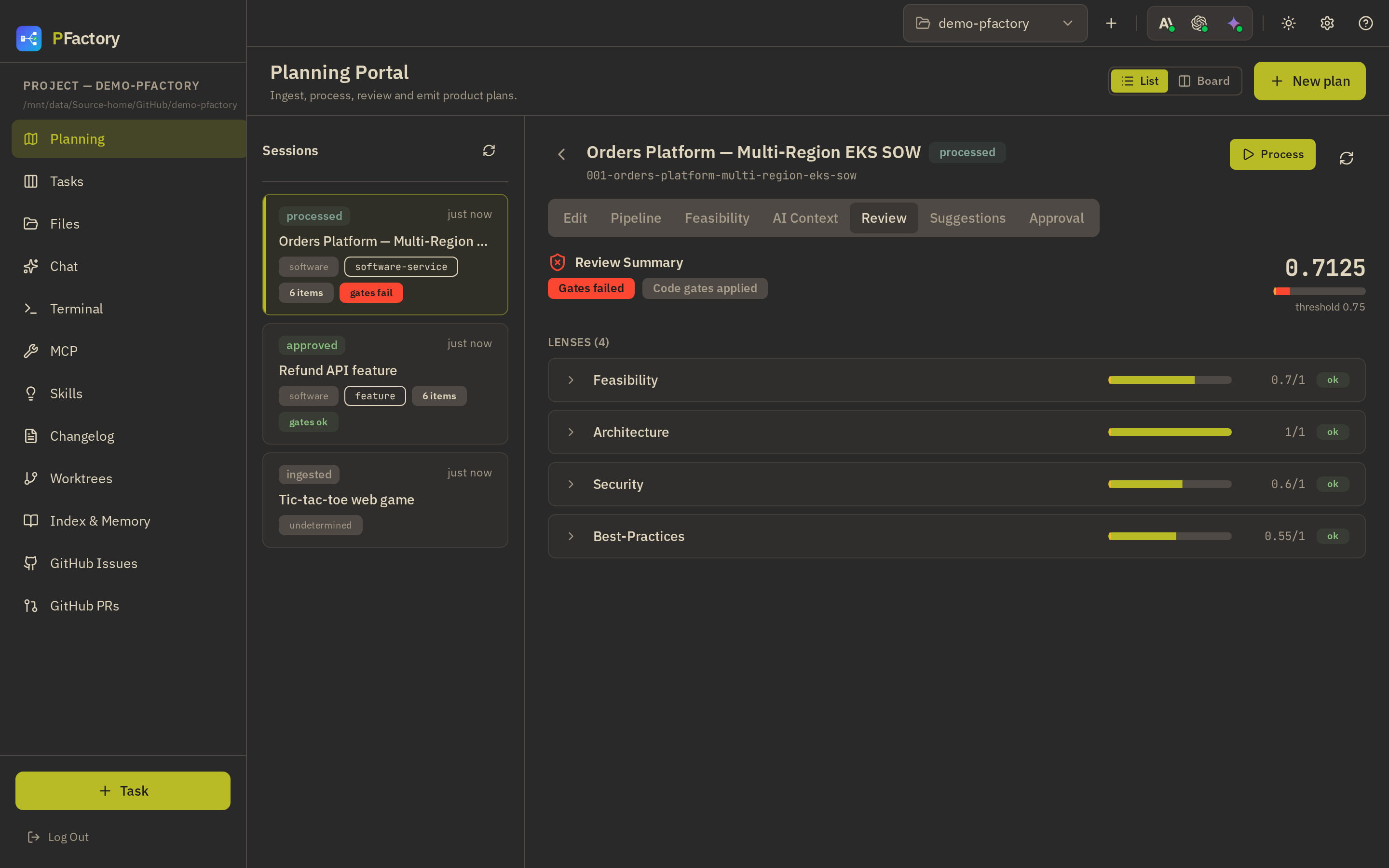
The planning layer that sits in front of coding agents. It ingests plans, enriches them with live organizational context (Kubernetes, AWS/Azure/GCP, Backstage, internal wikis), runs architecture / security / feasibility review gates with citations, records human approval, and emits governed GitHub issues.
- Context-grounded planning from real cloud + catalog state
- Hybrid deterministic + LLM review gates, every verdict cited
- Human-approval gate before any work is emitted
- Kanban board, feasibility & cost estimates, living templates
 Act
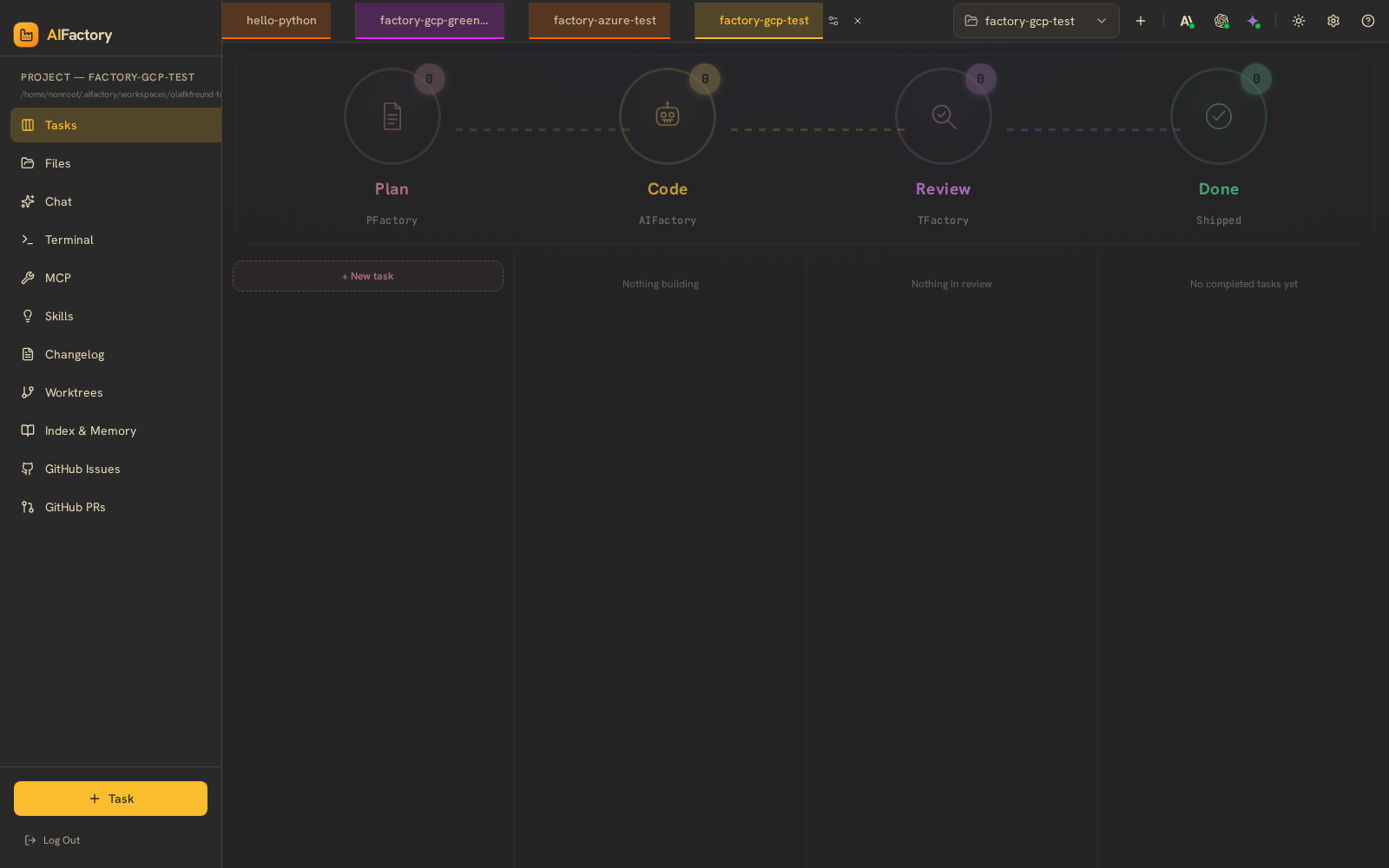
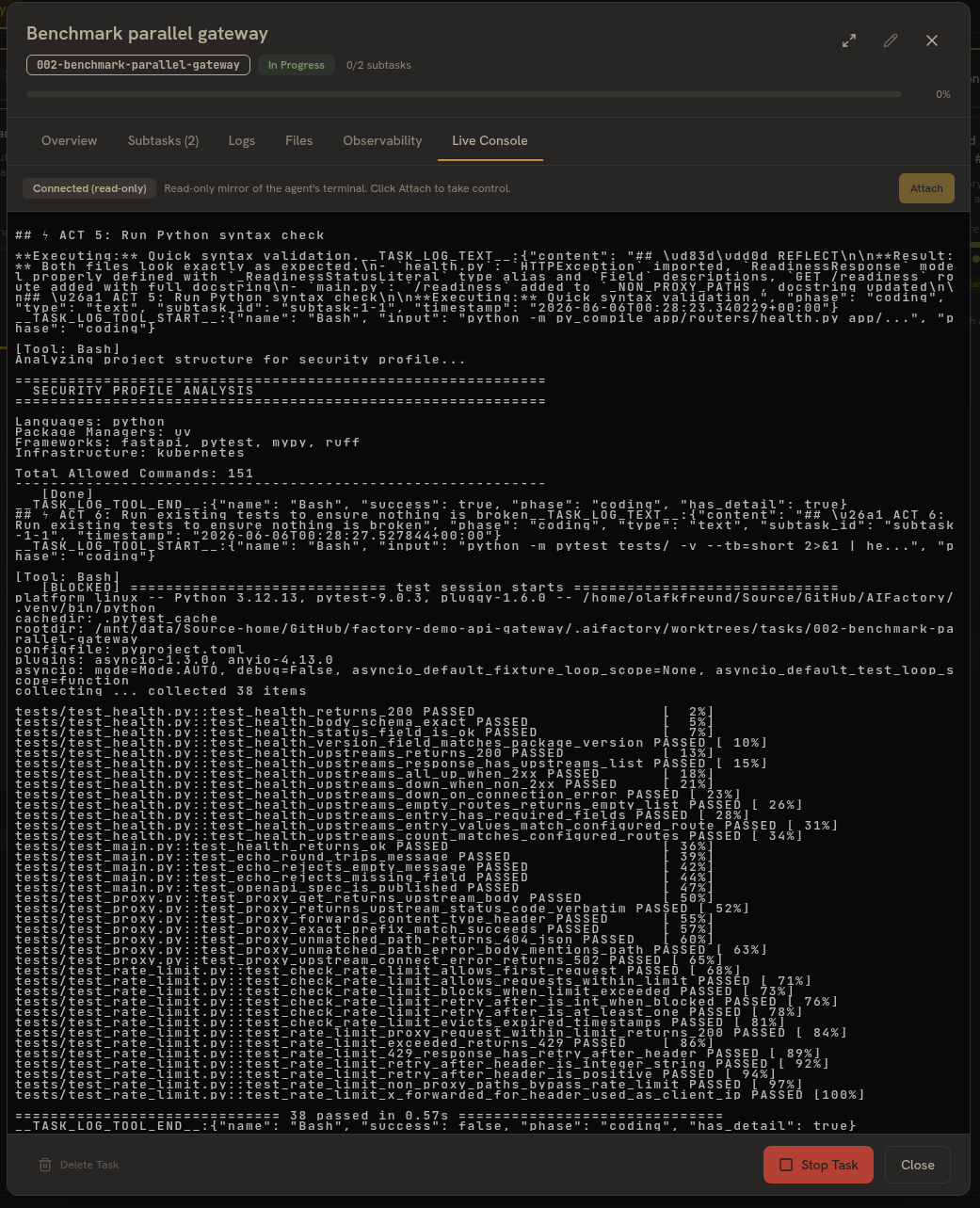
ActAIFactory — spec-first execution that ships merge-ready code
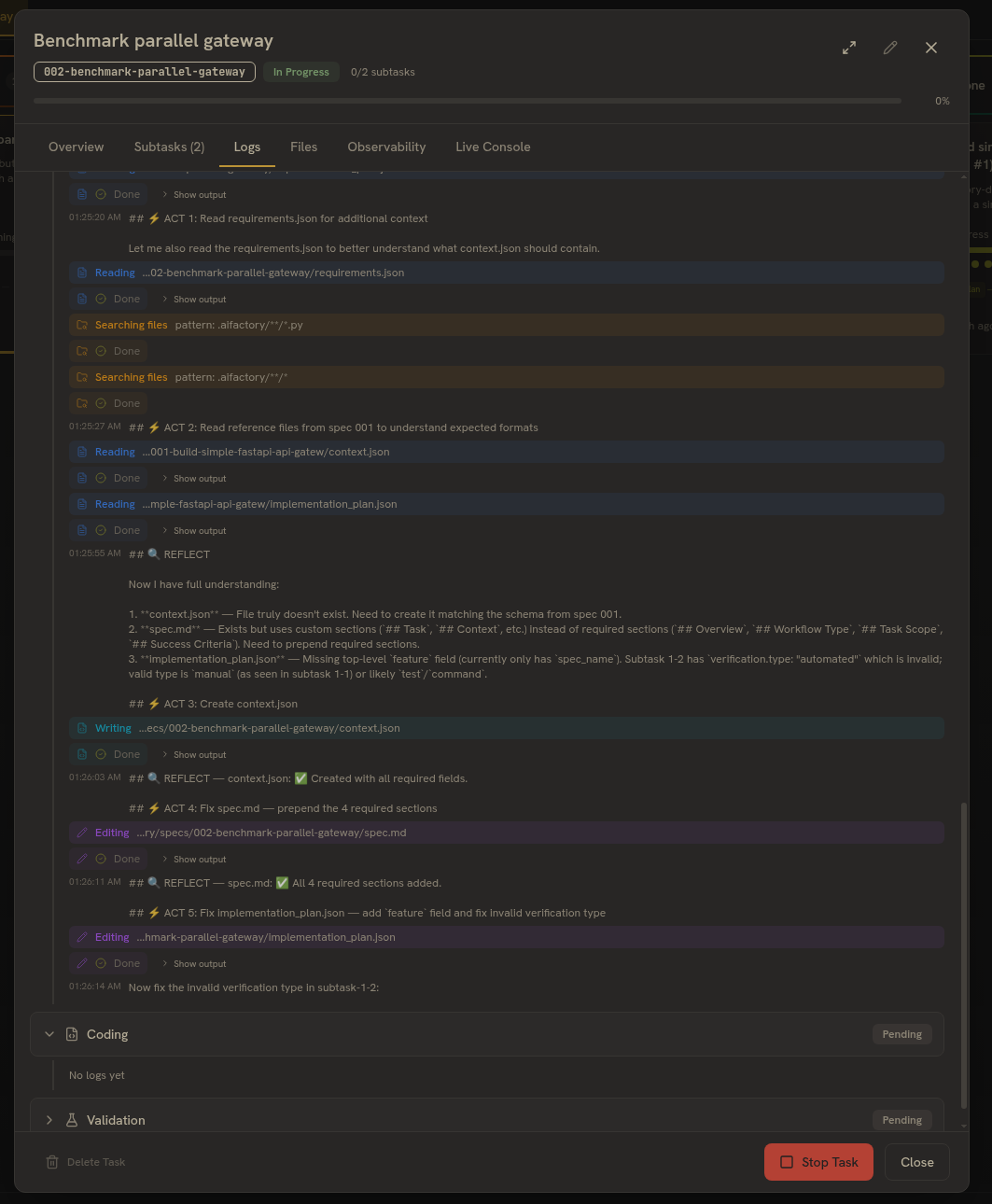
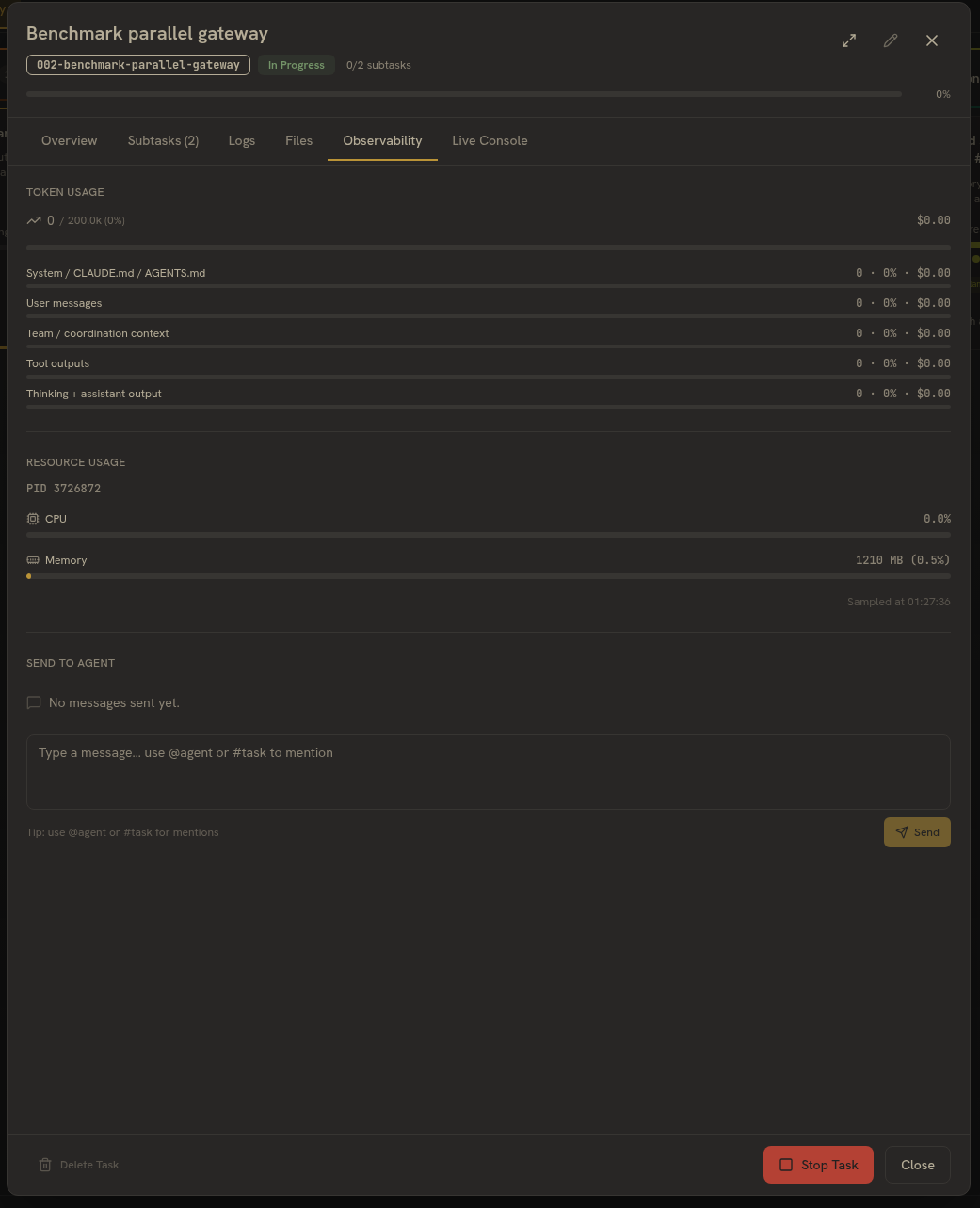
The swappable execution core — the Act stage of the pipeline. A planner writes a reviewable spec, a coder implements it in an isolated git worktree, and a QA agent validates against the spec — multi-provider, able to delegate to GitHub Copilot or GitLab Duo, and enterprise-grade. Because Prepare, Reflect and Review live in separate products, the engine that actually writes code can be replaced without touching the governance, verification or observability around it.
- Spec-first: every run starts from a written, editable spec
- Isolated worktrees — nothing touches main until you merge
- Multi-provider, per-phase model selection; MCP control plane
- Enterprise: SAML/SCIM, tenant isolation, audit, LiteLLM gateway
 Reflect / Review
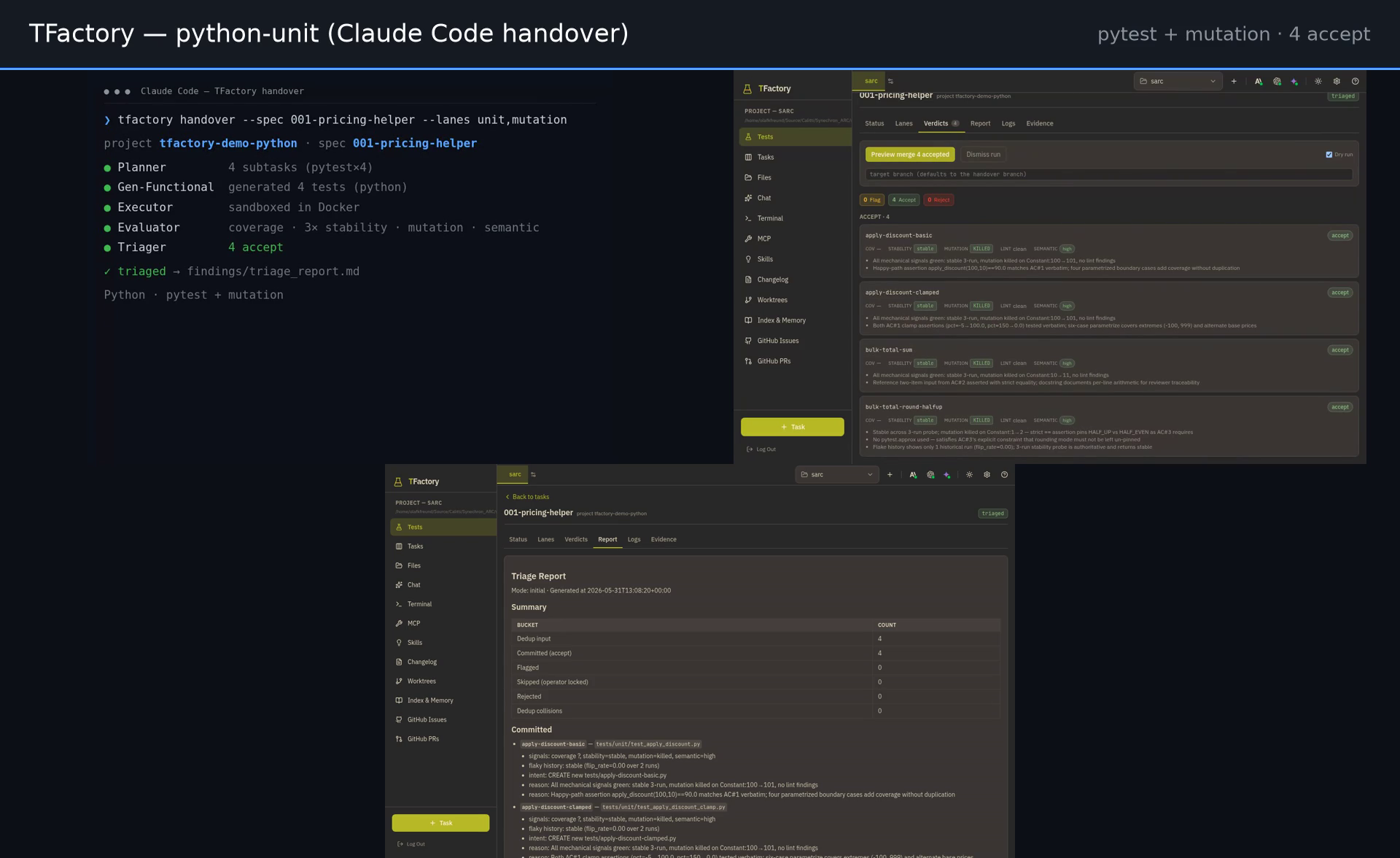
TFactory — tests you can trust, not just a green bar
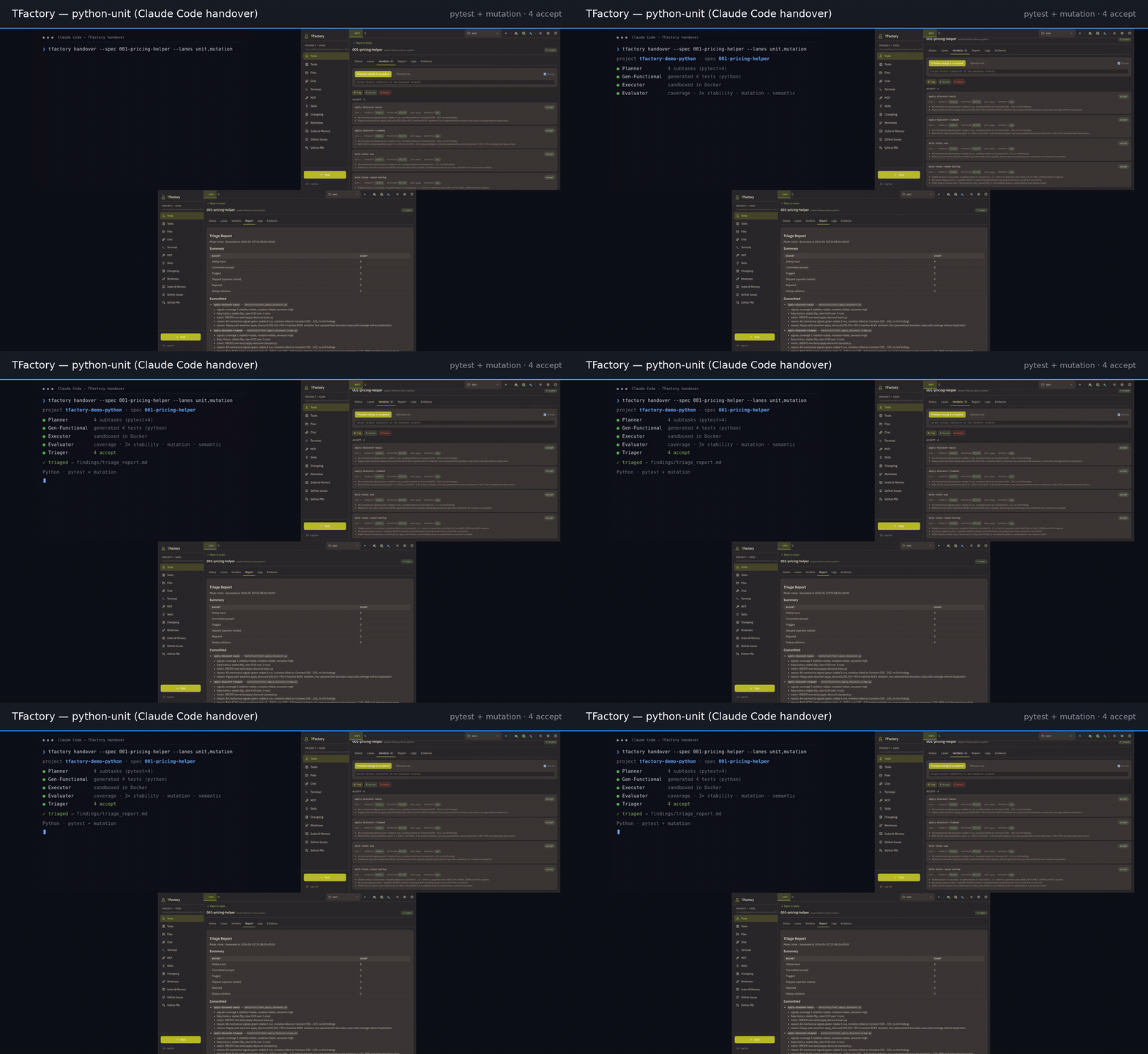
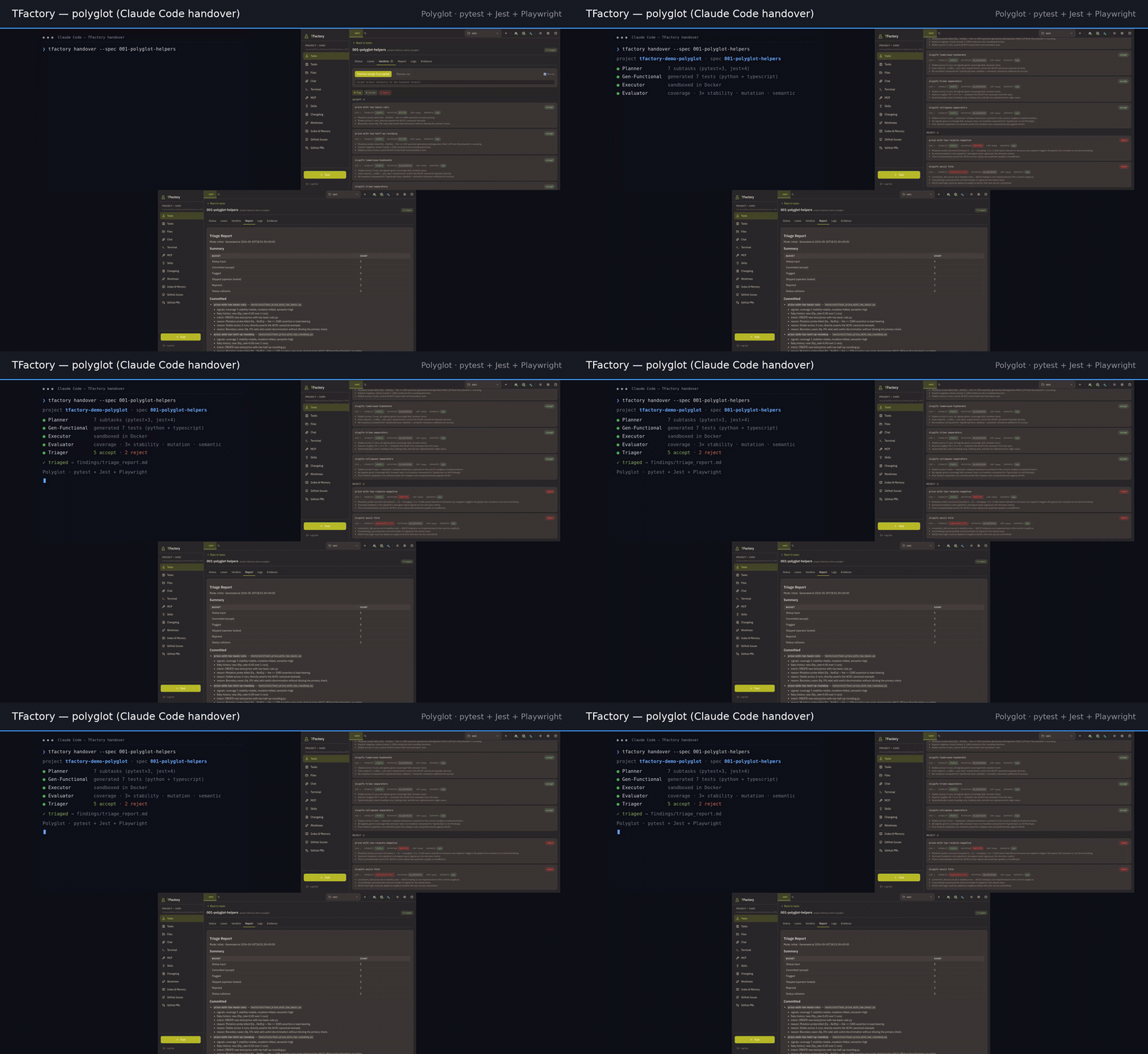
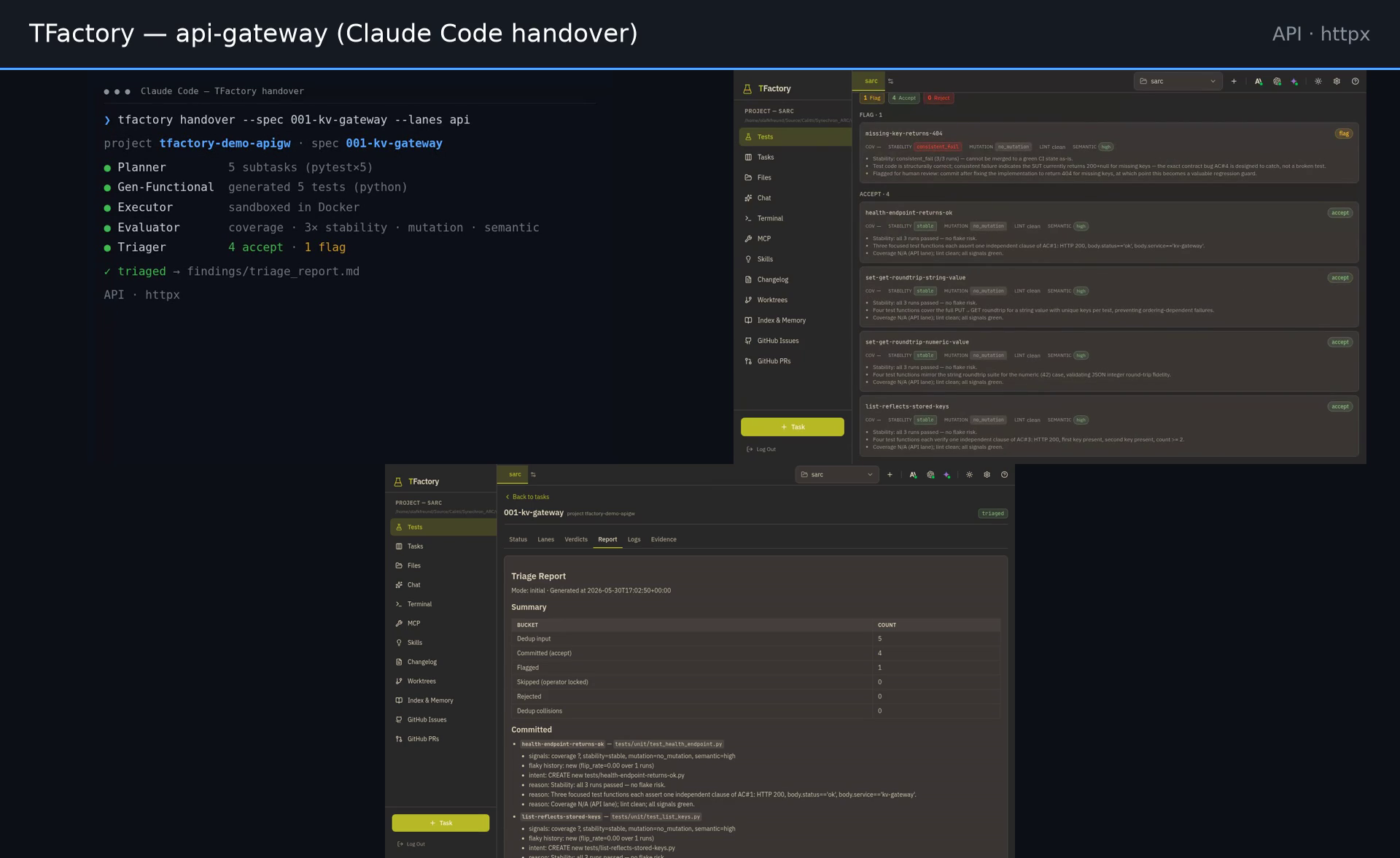
Autonomous test generation + execution across modality lanes (unit, browser, API, integration, mutation). It grades every generated test on a 5-signal verdict — coverage delta, stability re-runs, mutation kills, lint, semantic relevance — and posts a ranked triage report to your PR.
- Five-signal verdict: meaningful tests, not coverage theatre
- Modality lanes with real evidence (screenshots, video, HAR, mutants)
- Bidirectional handback: failures route back to AIFactory’s QA fixer
- Works from any AC source (markdown / Gherkin / EARS) or MCP
 Review / Observe & Steer — new
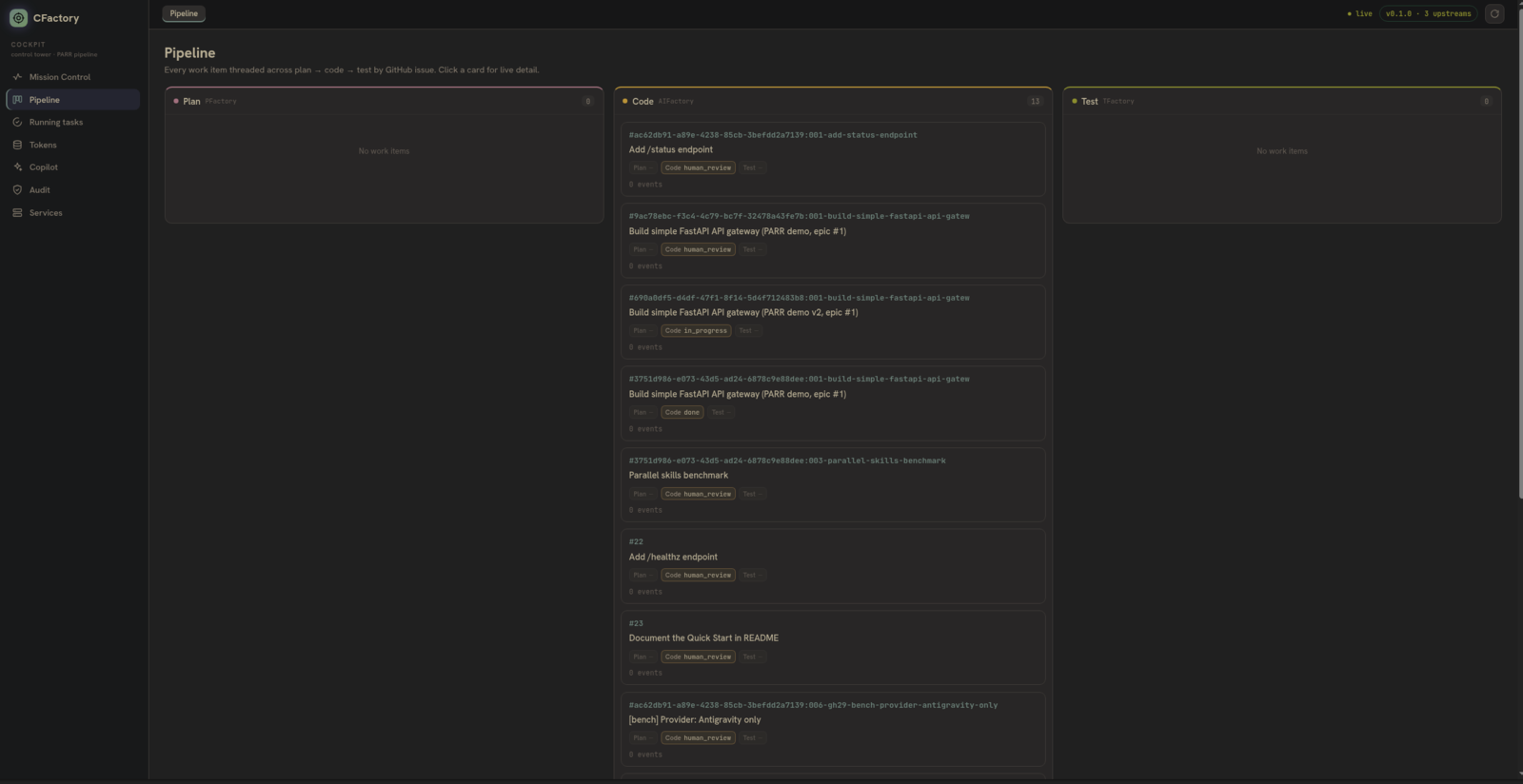
CFactory — the control tower over all three
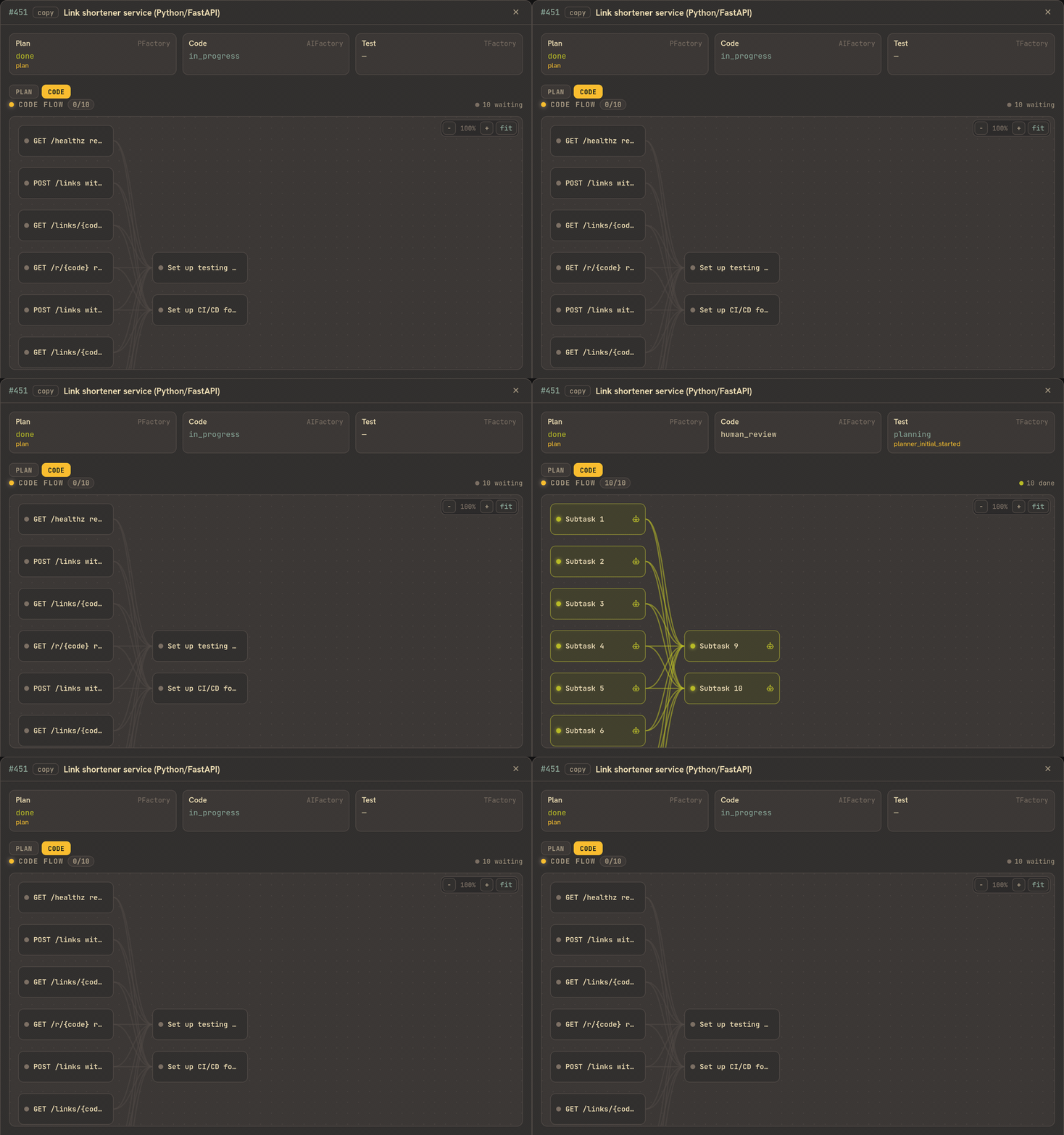
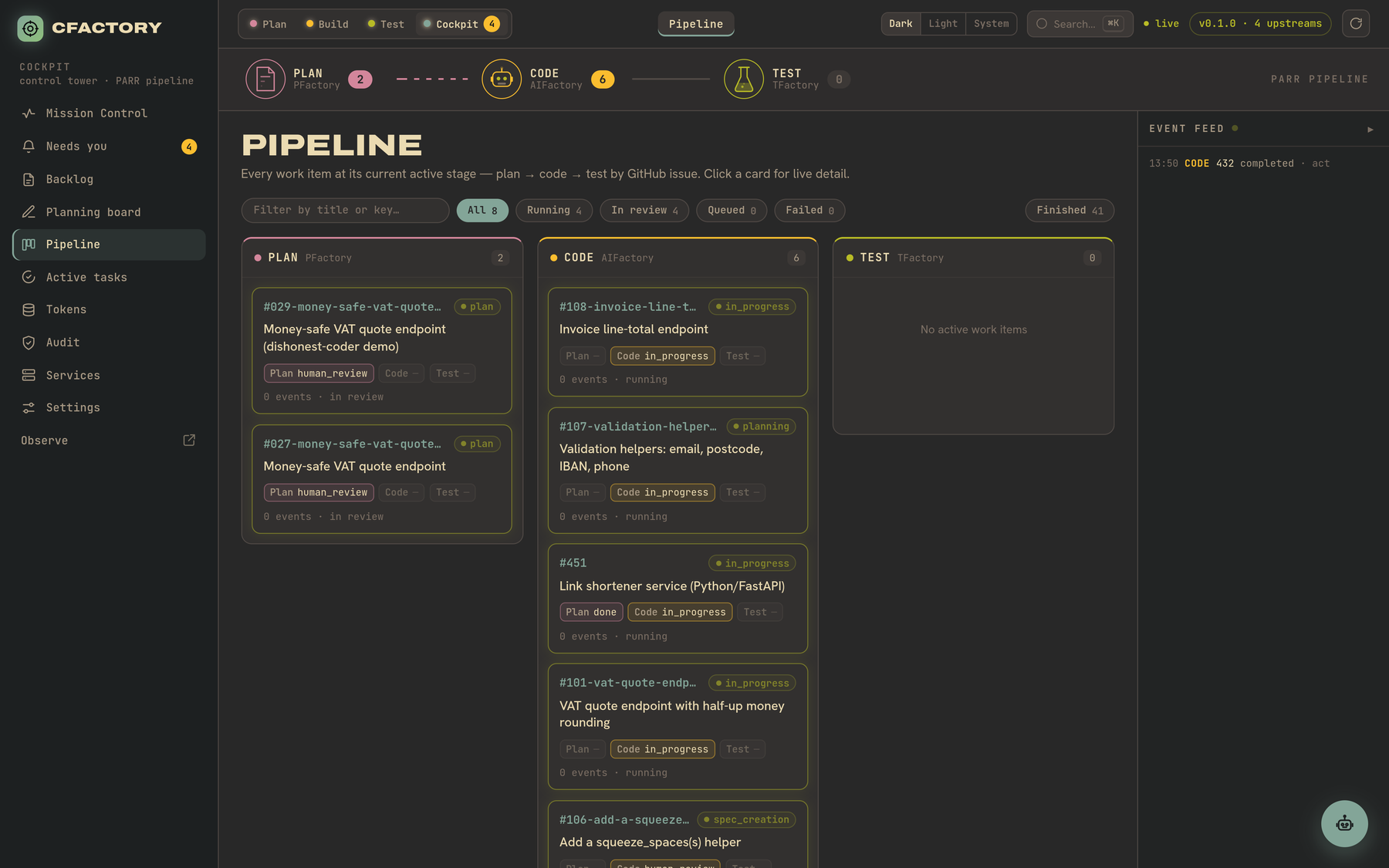
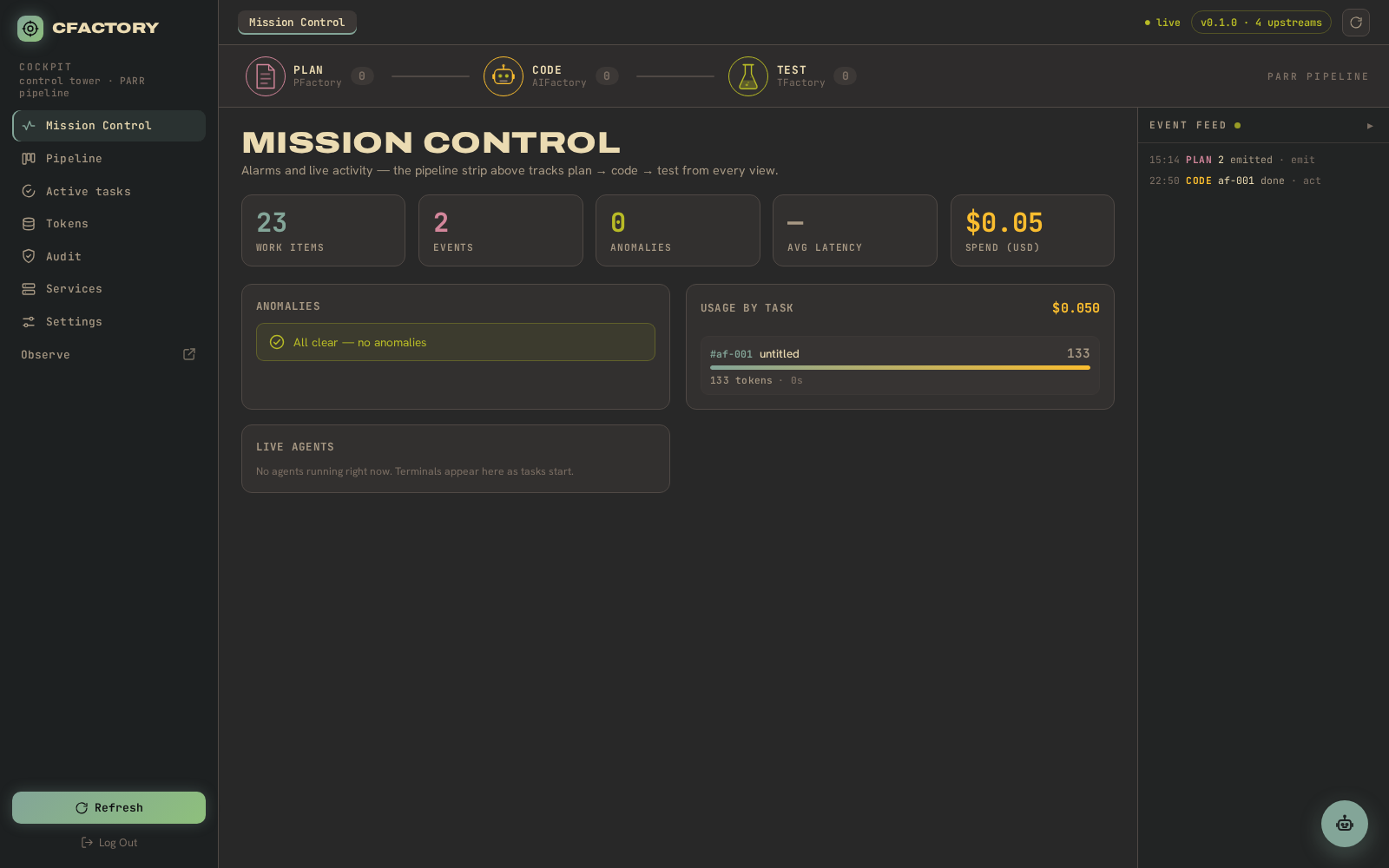
The newest member and the piece that turns the others into a suite. CFactory
threads every unit of work across the three services into one WorkItem (keyed by
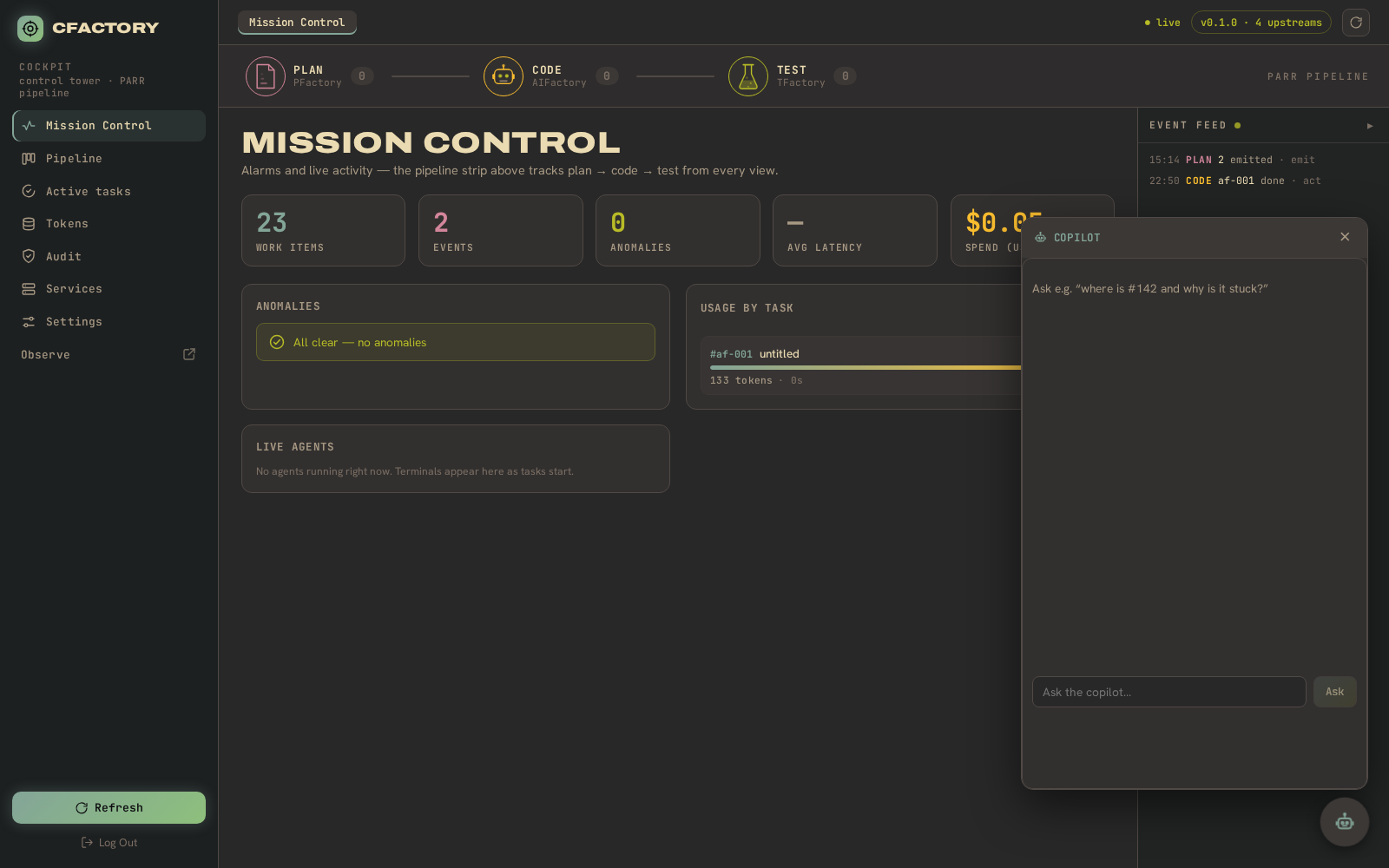
GitHub issue), shows it on a single live cockpit, and adds an agentic copilot
that explains pipeline state and proposes human-confirmed actions.
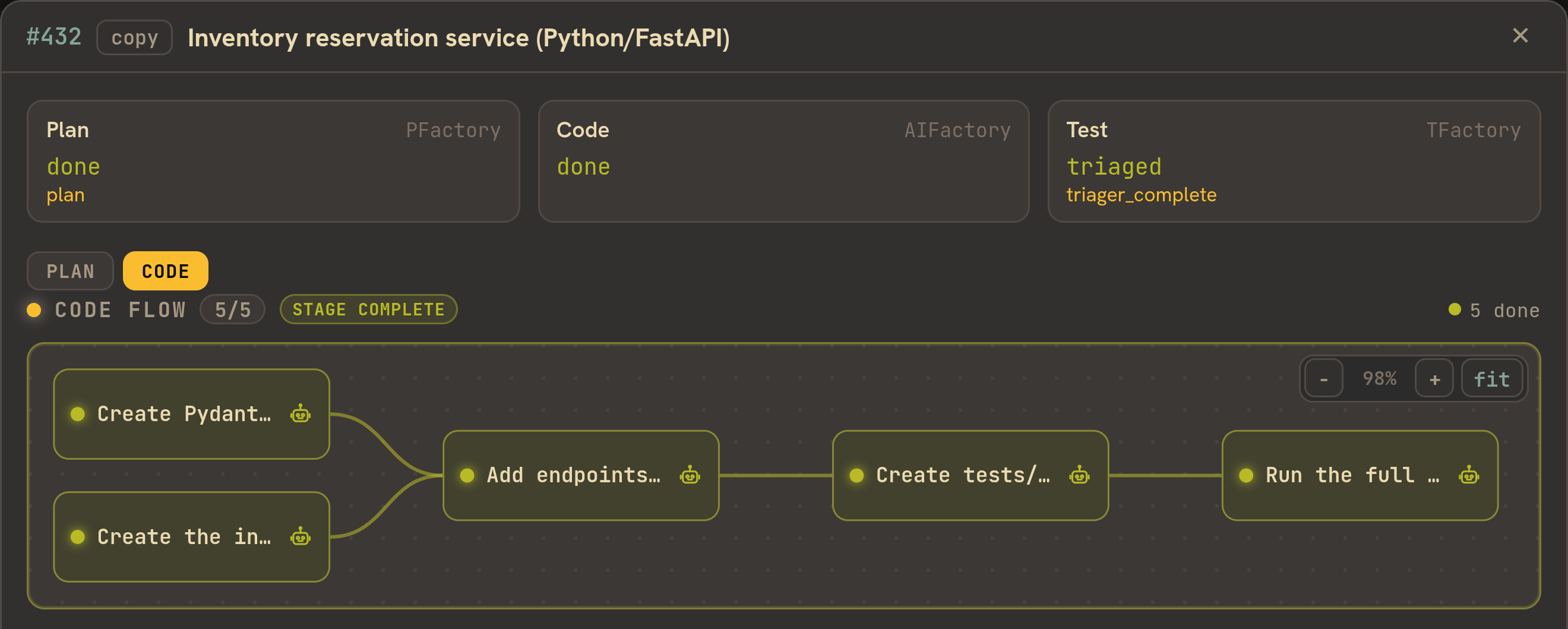
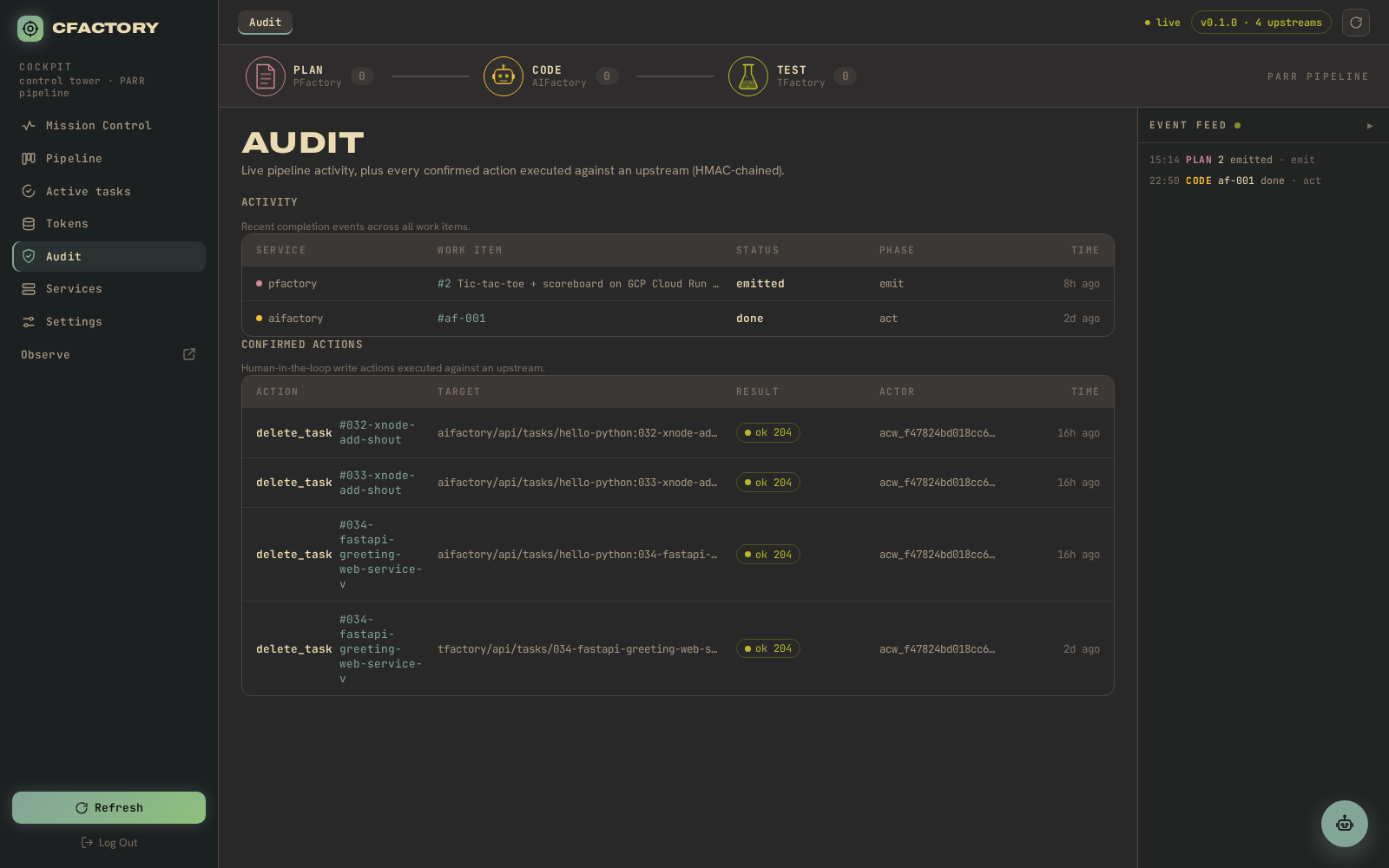
- One pane of glass: where is every feature across plan → code → test
- Agentic copilot: “why is #182 stuck?”, answered from real cross-service state
- Advise + confirm: the copilot prepares actions; a human always clicks
- Built on the family skeleton; reuses AIFactory’s enterprise security
How they cooperate
The products are independently useful, but their real power is the handoff chain — the cooperation we’re building out:
- PFactory → AIFactory. PFactory emits governed GitHub issues; AIFactory picks them up and builds, carrying the issue number as provenance.
- AIFactory → TFactory. A finished feature on a branch is handed to TFactory, which generates and grades a test suite against the acceptance criteria.
- TFactory → AIFactory (handback). When tests fail, TFactory routes a correction request back to AIFactory’s QA fixer — a bounded, closed loop.
- CFactory over everything. A shared correlation key — the GitHub issue
number — threads
plan → code → branch/PR → tests, so CFactory can show and steer the whole pipeline from one place.
observes every step ·
threads by issue #"] -.-> PF C -.-> AF C -.-> TF classDef pf fill:#2b3a37,stroke:#83a598,stroke-width:2px,color:#cfe6de,font-weight:bold; classDef af fill:#3a2b18,stroke:#fe8019,stroke-width:2px,color:#f6cfa6,font-weight:bold; classDef tf fill:#33360f,stroke:#b8bb26,stroke-width:2px,color:#e2e4a0,font-weight:bold; classDef cf fill:#3a3115,stroke:#fabd2f,stroke-width:2px,color:#f6dd98,font-weight:bold; class PF pf; class AF af; class TF tf; class C cf;
The connective tissue — a shared correlation key, a normalized completion-event schema, and a canonical local port map — is tracked as the PARR-spine epic in this repo.
See the full architecture → · Program roadmap → · Follow the blog →